

Between September 16–19, 2025, I presented my ongoing research on machine learning for skin cancer diagnosis at the XIII Scientific Conference of Eduardo Mondlane University (UEM), one of the university’s most important academic events. I presented the current stage of my master’s dissertation research, entitled “Using Machine Learning for Skin Cancer Diagnosis: Case Study of Maputo Central Hospital”, developed under the supervision of Prof. Dr. Orlando Zacarias.
The ongoing research aims to develop an accessible computational tool to support the early diagnosis of skin cancer, a serious public health issue in Mozambique. In the presentation, I covered the problem’s context, objectives, literature review, identified gaps, proposed methodology, and expected results.
For full conference details, visit the official website: https://conferenciacientifica.uem.mz/
Questions and Reflections on Machine Learning for Skin Cancer Diagnosis
The presentation was not only an opportunity to showcase my research, but also to receive valuable feedback from the audience, which helped me reflect and refine crucial aspects of the project. Some key questions included:
- “Since patient data is private, how do you intend to ensure privacy?”
Answer: All data will be anonymized and aggregated, with any personally identifiable information removed. Access will be restricted, and the data will be used strictly for research purposes, following the ethical guidelines of UEM and HCM. This concern will be explicitly detailed in the ethics section of the dissertation.
- “What exactly is ‘accuracy’ and what does it mean?”
Answer: Accuracy measures the percentage of correct predictions made by the model compared to the total predictions. Simply put, it reflects how “on target” the model is. Other metrics such as Sensitivity (ability to correctly identify positive cases) and Specificity (ability to correctly identify negative cases) are equally important in a medical context.
- “How were the algorithms chosen, given that data collection has not yet been carried out?”
Answer: The initial choice was based on literature review and algorithm characteristics. SVM was selected as the primary focus due to its proven effectiveness with datasets of manageable size (as expected in this case) and its robustness against overfitting. However, this is a preliminary choice. The final model will be determined empirically after data collection and analysis, through a rigorous comparison of all tested algorithms. This justification will be expanded in the dissertation.
- “Considering the hospital’s lack of resources, what are the strategies to make the project sustainable?”
Answer: This was a crucial question I had not deeply considered before. As an initial response, I mentioned seeking investments from public and private institutions, demonstrating the project’s importance to public health. This feedback prompted me to reflect further, and a dedicated section on long-term sustainability strategies will be added to the dissertation.
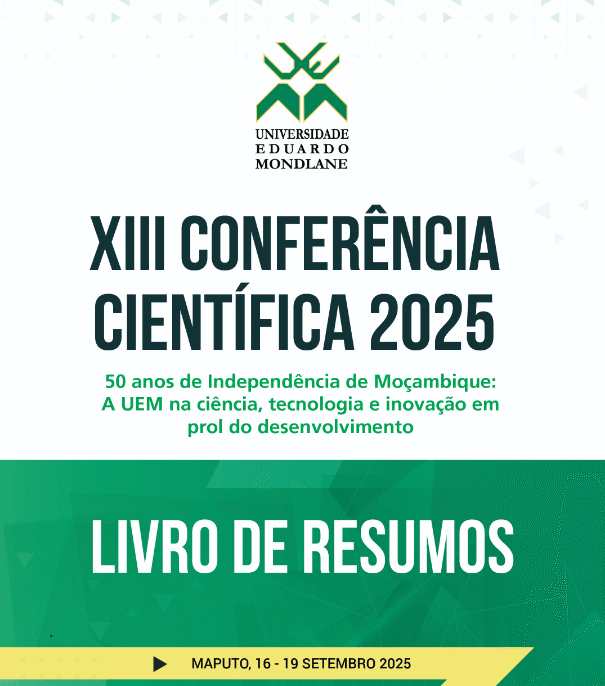
Conference Abstract Book
My abstract was published in the conference’s abstract book. Those interested in reading it can find it on page 592 of the XIII Scientific Conference – 2025.

We invite everyone to read it and, if possible, share their feedback. Every contribution is welcome to make this research more robust and well-structured.
I am grateful to all who participated and contributed to this enriching debate. Stay tuned for future updates on the progress of this research!
Thank you very much!
“Technology only has value when it serves people…”
One reply on “Presentation of My Research at the XIII UEM Scientific Conference”
Donaldo Mariquele September 20, 2025 at 5:03 pm
Well done.